


Blog
- 2026-08-31
- Finox Pellets Industries
Sodium Hydroxide Pellets: Properties, Applications & Why Grade Matters
Sodium Hydroxide is a familiar name in the chemical industry. Also known as caustic soda, it is used across chemical manufacturing, water treatment, pharmaceuticals, detergents, textiles and many other industrial processes.
But buying Sodium Hydroxide is not simply a matter of choosing a product by name.
The grade, purity, physical form and application all matter.
A material that works well for one process may not necessarily be the right choice for another. For manufacturers and laboratories, understanding these differences can make product selection much easier—and help avoid problems later in the process.
What Makes Sodium Hydroxide So Widely Used?
At its core, Sodium Hydroxide is a strong alkali with a wide range of chemical applications. It reacts readily with acids and is commonly used to adjust pH, break down materials, support chemical reactions and assist in cleaning and processing.
Its versatility is one of the main reasons it has remained an important industrial chemical for decades.
Sodium Hydroxide is available in different physical forms, including pellets and powder. The choice between them often comes down to how the material needs to be handled, stored, measured and introduced into a particular process.
Understanding Sodium Hydroxide Pellets
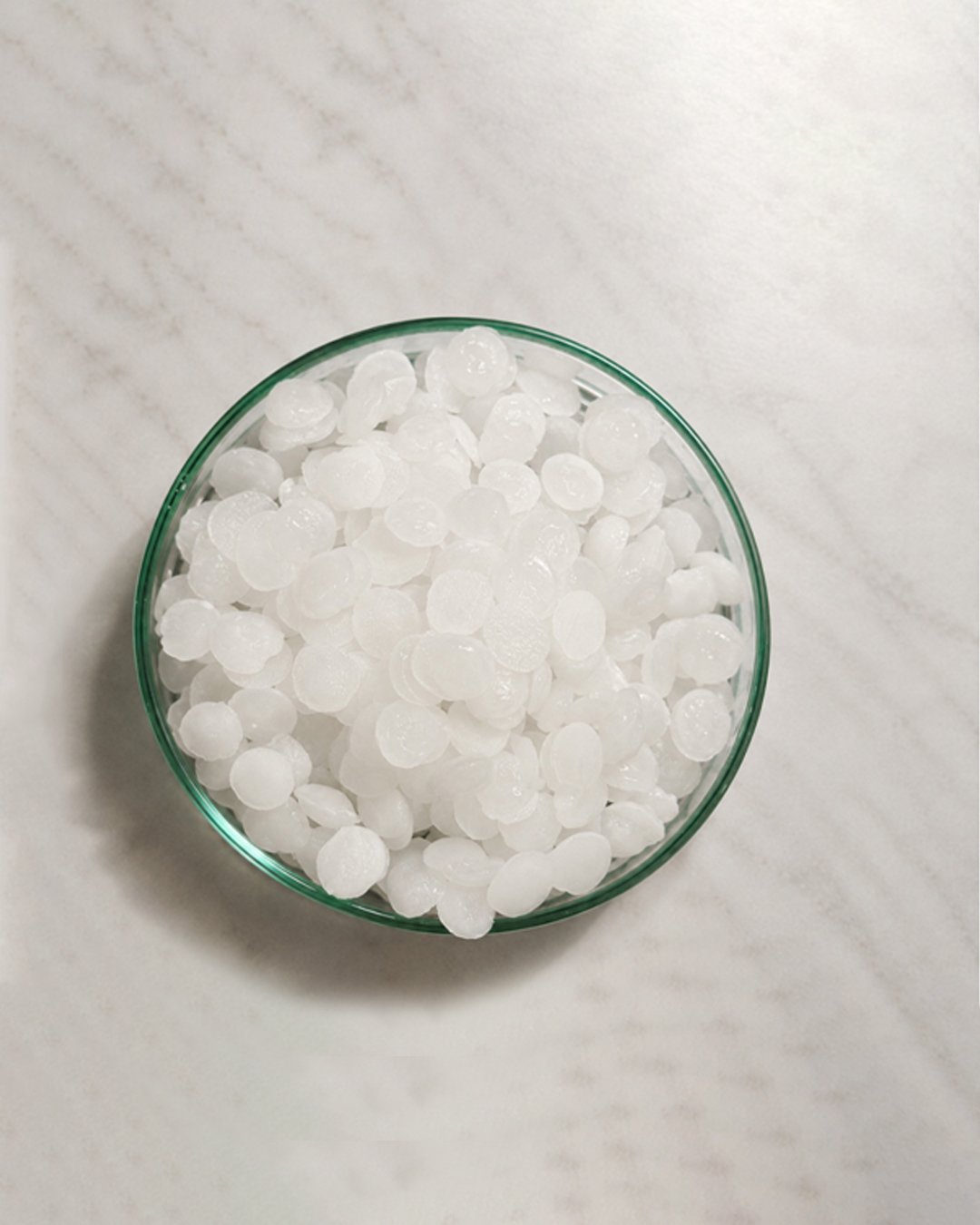
Sodium Hydroxide pellets are small, solid particles of caustic soda. Their compact form can make them convenient for controlled handling and dosing in many applications.
They are white in appearance and readily dissolve in water. At the same time, Sodium Hydroxide has a strong tendency to absorb moisture from the atmosphere. This makes packaging and storage an important part of maintaining product quality.
And there is another point that should never be overlooked: Sodium Hydroxide is highly corrosive. Appropriate protective equipment, handling procedures and storage conditions are essential wherever the material is used.
Where Are Sodium Hydroxide Pellets Used?
There is no single industry that defines Sodium Hydroxide.
It moves across industries because its chemistry allows it to perform very different roles.
Common applications include:
- Chemical manufacturing
- Water and wastewater treatment
- Pharmaceutical manufacturing
- Detergent and cleaning products
- Textile processing
- Pulp and paper
- Laboratory applications
- pH adjustment and process control
- Various specialty chemical processes
The requirements, however, can change significantly from one application to another. -
That brings us to one of the most important parts of selecting Sodium Hydroxide: the grade.
Why Does the Grade Matter?
The words LR, AR and ACS may look familiar to anyone who regularly purchases laboratory or specialty chemicals. But these designations are not simply different names for the same product.
The required specification depends on where and how the material will be used.
For a laboratory, purity and controlled impurities may be critical. For another industrial process, the focus may be on a different set of parameters defined by the process itself.
This is why we believe product selection should start with a simple question:
What is the material going to be used for?
Once the application is understood, the appropriate grade and specification become much easier to determine.
Pellets or Powder?
The right physical form depends on the process.
Pellets can be useful where controlled addition, storage and handling are important. Powder may be preferred for other processes depending on equipment, formulation and production requirements.
There is no universal answer.
The best choice is the one that fits the customer's process.
What Should You Check Before Buying?
A chemical specification sheet can tell you a lot—but knowing what to look for is equally important.
Before selecting Sodium Hydroxide, consider:
Application
Where will the material be used?
Grade
Does the application require LR, AR, ACS or another defined specification?
Purity
What purity level and impurity limits are required?
Physical form
Would pellets or powder work better for the process?
Documentation
Are COA, TDS, MSDS and other quality documents required?
Packaging
Will the packaging provide adequate protection during storage and transportation?
These questions may seem basic, but they are often what separates a suitable raw material from an unsuitable one.
From a Product to a Process
At Finox Pellets Industries, we look at Sodium Hydroxide as more than just a chemical product.
Every customer has a process behind the requirement.
There is a formulation, a production line, a laboratory, a treatment system or a manufacturing operation that the material needs to fit into. Understanding that requirement is the starting point for supplying the right product.
Our focus is to build that understanding into the way we work—from product quality and specifications to packaging and supply.
Building Beyond Boundaries
Chemicals do not stop at borders.
A product manufactured in India can become part of a process anywhere in the world. That creates a responsibility—not only to manufacture, but to build the quality, consistency and reliability expected by customers across markets.
At Finox Pellets Industries, that is the direction we are building towards.
From India to the world.
Not simply as a supplier of Sodium Hydroxide, but as a chemical partner that understands the material, the application and the people who depend on it.
Location
Plot No. 86/4,Phase-1, GIDC Vatva, Ahmedabad-382 445, Gujarat, India.